Batch-Documented
HPLC-Verified
Independent Assay
Same Reorder Price
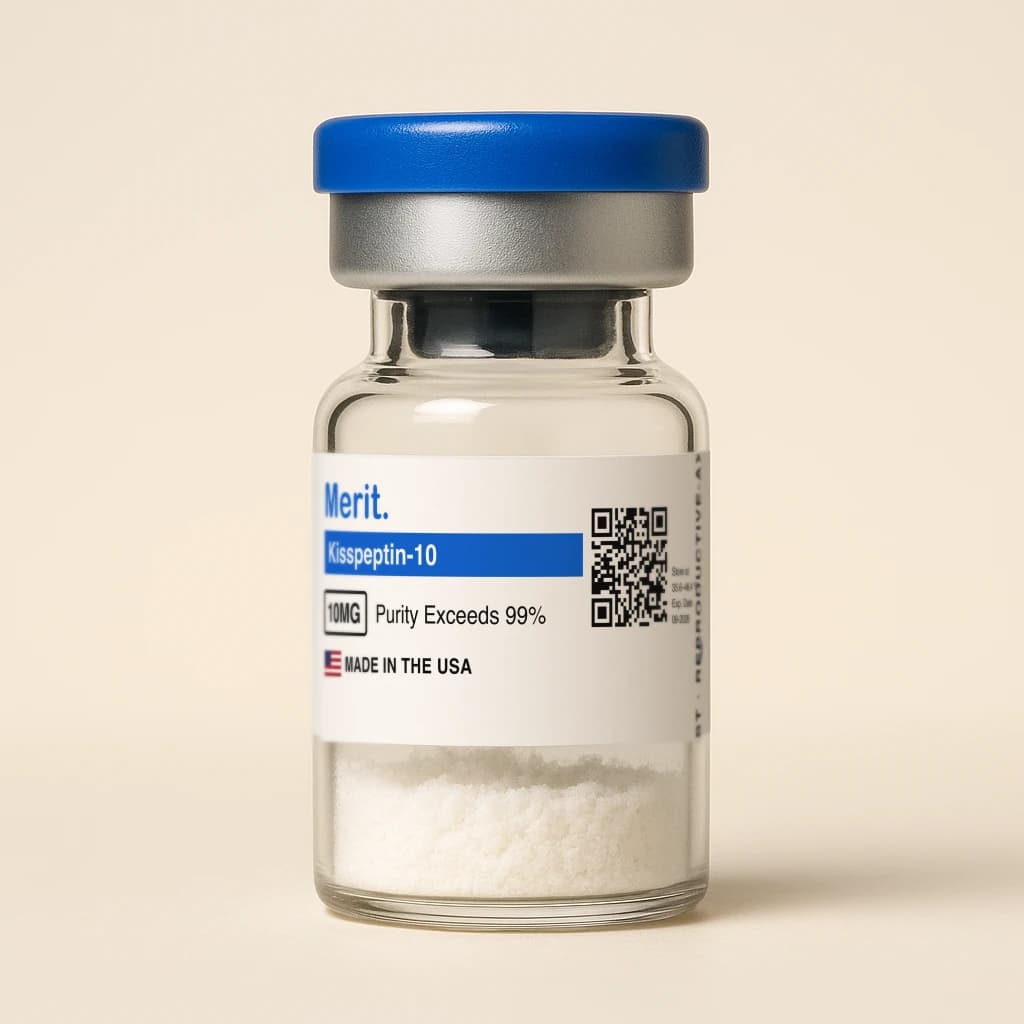
Kisspeptin-10 10 mg
Lyophilized vial · 10 AA
Kisspeptin-10 — independently assayed, batch-tested, and shipped from our fulfillment facility in San Antonio. Released only after an independent laboratory returns its results for the batch.
Per vial
Select your pack size
SingleShips within 48 hours from San Antonio
UPS Ground · tracked + insured · released after independent lab testing
- Purity Guarantee. If a batch fails our ≥99% HPLC standard, full refund + replacement.
- Batch certificate in the COA library, anytime, free
- Same reorder price — forever, no upcharge
$69.99
Single
— About this compound
Kisspeptin-10.
Class · Endogenous decapeptide, RFamide peptide family (Tyr-Asn-Trp-Asn-Ser-Phe-Gly-Leu-Arg-Phe-NH₂) — the C-terminal 45–54 fragment of the KISS1 gene product metastin / kisspeptin-54
Origin. Identified in 2001 by Ohtaki and colleagues, who isolated the amidated 54-residue KISS1 gene product metastin from human placenta and showed it to be the endogenous ligand of the orphan receptor hOT7T175 (GPR54, now KISS1R). Kisspeptin-10 is the C-terminal 45–54 fragment of that peptide, derived from the KISS1 metastasis-suppressor gene.
Kisspeptin-10 is the C-terminal decapeptide of metastin, the 54-residue, carboxy-terminally amidated product of the KISS1 gene. KISS1 was characterised in the 1990s as a suppressor of melanoma and breast-carcinoma metastasis, but its peptide product was not matched to a receptor until 2001, when Ohtaki and colleagues at Takeda isolated metastin from human placenta and identified it as the endogenous ligand of the orphan G-protein-coupled receptor hOT7T175 — the receptor subsequently known as GPR54 and now designated KISS1R. The 45–54 fragment retains receptor-activating potency and is the form most commonly used in laboratory work. Like other members of the RFamide family, the decapeptide terminates in an amidated Arg-Phe motif; that C-terminal amide is a structural requirement rather than a formality, and the free-acid form YNWNSFGLRF-OH is a different compound, not KP-10.
The field was opened by human genetics rather than by pharmacology. In 2003 two groups reported independently — de Roux and colleagues in PNAS, and Seminara and colleagues in the New England Journal of Medicine — that loss-of-function mutations in GPR54/KISS1R segregate with idiopathic hypogonadotropic hypogonadism, with affected individuals showing absent or arrested puberty and low gonadotropins despite an anatomically intact hypothalamus and pituitary. Because the pituitary in those individuals remained responsive to exogenous gonadotropin-releasing hormone (GnRH), the lesion was placed upstream of the GnRH neuron. That work positioned kisspeptin signalling as a proximate gatekeeper of the hypothalamic-pituitary-gonadal axis rather than as a peripheral modulator, and it remains the principal evidence for that placement.
Human investigation of the peptide has been conducted largely as academic clinical research, much of it by Waljit Dhillo's group at Imperial College London. Dhillo and colleagues reported the first administration of kisspeptin-54 to healthy male volunteers in 2005, observing higher plasma LH, FSH and testosterone during the peptide infusion than during the saline control in those six enrolled subjects. Jayasena and colleagues subsequently characterised kisspeptin-10 specifically and reported a marked sexual dimorphism among their participants: gonadotropin release was observed in the healthy men studied and in women studied during the preovulatory phase, but not in women studied during the follicular phase. A 2015 head-to-head study from the same group compared intravenous kisspeptin-10, kisspeptin-54 and GnRH in healthy men and reported that at the levels tested the two kisspeptin species were associated with broadly similar gonadotrophin secretion as one another, while GnRH was associated with higher levels than either. These are findings in small enrolled study populations under controlled clinical conditions, reported here as literature only; Merit Sciences material is supplied strictly for laboratory research use and is not for human or veterinary administration.
— Common research applications
- KISS1R (GPR54) receptor pharmacology and agonist characterisation
- Hypothalamic-pituitary-gonadal axis and GnRH pulse-generator neuroendocrinology
- Models of pubertal onset and idiopathic hypogonadotropic hypogonadism
- RFamide peptide structure-activity and C-terminal amidation studies
- KISS1 metastasis-suppressor biology in oncology models
— Mechanism
How it's been studied.
Kisspeptin-10 is described in the literature as a high-affinity agonist at KISS1R (GPR54), a Gq/11-coupled receptor whose activation drives phospholipase C-β, inositol trisphosphate generation, intracellular calcium mobilisation and ERK1/2 phosphorylation. KISS1R is expressed on GnRH neurons of the hypothalamus, and the proposed mechanism situates kisspeptin one synaptic step upstream of the GnRH pulse generator: kisspeptinergic neurons in the arcuate nucleus and the anteroventral periventricular nucleus are held to relay gonadal steroid feedback and metabolic state onto GnRH neurons, which in turn govern pituitary gonadotropin release. The human loss-of-function genetics are the principal evidence for this placement — inactivating KISS1R mutations produce hypogonadotropic hypogonadism while the pituitary remains responsive to exogenous GnRH. Consistent with an action upstream of the pituitary rather than at it, the 2015 human comparison found GnRH associated with higher gonadotrophin output than either kisspeptin species at the levels tested. Receptor desensitisation on sustained exposure, and rapid enzymatic cleavage of the decapeptide, are recurring variables in the published pharmacology and remain areas of active investigation.
Mechanism descriptions reflect findings reported in the preclinical and basic-research literature. They are not clinical conclusions and not statements of therapeutic effect.
— The Chemistry
The numbers, plainly.
CAS
374675-21-5
Molecular weight
1302.4 Da
Formula
C63H83N17O14
Sequence
YNWNSFGLRF-NH₂
Format
Lyophilized powder
Vial dose
10 mg
Purity (HPLC)
≥99%
Amino acids
10
Half-life
Short, and markedly shorter than that of the parent 54-mer. In the 2005 human infusion study by Dhillo and colleagues the plasma half-life of kisspeptin-54 was calculated at 27.6 ± 1.1 minutes. A comparably precise human plasma half-life for kisspeptin-10 could not be confirmed against the primary sources checked for this entry, so no figure is asserted for it here; the draft value of "approximately 4 minutes" was removed for that reason. What is documented is rapid loss of the decapeptide: Liu and colleagues (2013) reported decomposition half-lives of 6.8, 2.9 and 1.7 minutes in rat plasma at 4 °C, 25 °C and 37 °C respectively, with cleavage of the N-terminal tyrosine as the principal decomposition route, and rapid elimination in rats following intravenous bolus. Brief circulating persistence is therefore a defining experimental variable in the published record. Stated for interpretation of the research literature only; not a handling, preparation or administration instruction.
Solubility
Supplied lyophilised, commonly as the trifluoroacetate or acetate salt. Reported as soluble in water and in aqueous buffers. The single arginine together with the free N-terminus gives the peptide a net positive charge at neutral pH, while the tryptophan and two phenylalanine residues contribute local hydrophobicity. Published stability work on the decapeptide reports rapid decomposition in plasma at ambient and physiological temperature, with loss of the N-terminal tyrosine as the principal route; tryptophan-containing peptides are more generally reported as oxidation-sensitive. Physicochemical context only — Merit Sciences publishes no preparation or reconstitution procedures.
View lab results for Kisspeptin-10 → or search by compound.
— Why Merit
The supplier difference.
How Merit compares to the two alternatives most research buyers consider for Kisspeptin-10.
Comparison reflects published facility status and standard industry practice. Compounding pharmacy availability of research peptides varies by jurisdiction.
— How it's made
From compound to your shelf.
Every Merit batch follows the same documented path. Five steps, every one verifiable.
- 01
Sourcing
Compound starts as a research-grade API.
Active pharmaceutical ingredient sourced from FDA-registered manufacturers. Identity confirmed against reference standard before any compounding begins.
- API from FDA-registered manufacturers
- Identity verified against reference standard
- Chain of custody documented
- 02
Compounding
Sterile-filled in a US cleanroom.
Lyophilized in a cleanroom at our US facility. The powder format gives ≥24 months sealed stability — no cold-chain shipping required.
- ISO-certified US facility
- ISO-certified manufacturing process
- Lyophilized powder for transit stability
- 03
Verification
Every batch HPLC-tested.
Reverse-phase HPLC-UV (UV/MS for higher-MW peptides) confirms identity and purity for every batch before it leaves the lab. The chromatogram is archived.
- Reverse-phase HPLC, per-batch
- ≥99% purity floor — every batch
- Chromatogram archived for every batch
- 04
Release
The batch is released against an independent assay.
No batch ships until an independent laboratory has returned its identity and purity results and the certificate is published in the COA library.
- Independent laboratory on every batch
- Certificate published before sale
- Every certificate is in the public COA library
- 05
Dispatch
Ships from San Antonio in 48 hours.
Sealed vials with a QR code on the label that opens the COA library. Order before 2pm CT Monday–Thursday for same-day dispatch. UPS Ground, tracked + insured.
- 48hr dispatch from San Antonio, TX
- QR code on every vial label
- UPS Ground, tracked + insured
Every step above can be verified for any specific batch by emailing rx@meritsciences.com with your order number.
— Research references
The published record.
Peer-reviewed work cited in the public scientific literature. Links resolve to PubMed or the publisher of record.
- 01
Metastasis suppressor gene KiSS-1 encodes peptide ligand of a G-protein-coupled receptor
Ohtaki T, Shintani Y, Honda S, Matsumoto H, Hori A, Kanehashi K, Terao Y, Kumano S, et al. · Nature · 2001
- 02
Hypogonadotropic hypogonadism due to loss of function of the KiSS1-derived peptide receptor GPR54
de Roux N, Genin E, Carel JC, Matsuda F, Chaussain JL, Milgrom E · Proceedings of the National Academy of Sciences of the United States of America · 2003
- 03
The GPR54 gene as a regulator of puberty
Seminara SB, Messager S, Chatzidaki EE, Thresher RR, Acierno JS Jr, Shagoury JK, Bo-Abbas Y, Kuohung W, et al. · The New England Journal of Medicine · 2003
- 04
Kisspeptin-54 stimulates the hypothalamic-pituitary gonadal axis in human males
Dhillo WS, Chaudhri OB, Patterson M, Thompson EL, Murphy KG, Badman MK, McGowan BM, Amber V, et al. · The Journal of Clinical Endocrinology and Metabolism · 2005
- 05
The effects of kisspeptin-10 on reproductive hormone release show sexual dimorphism in humans
Jayasena CN, Nijher GM, Comninos AN, Abbara A, Januszewki A, Vaal ML, Sriskandarajah L, Murphy KG, et al. · The Journal of Clinical Endocrinology and Metabolism · 2011
- 06
Direct comparison of the effects of intravenous kisspeptin-10, kisspeptin-54 and GnRH on gonadotrophin secretion in healthy men
Jayasena CN, Abbara A, Narayanaswamy S, Comninos AN, Ratnasabapathy R, Bassett P, Mogford JT, Malik Z, et al. · Human Reproduction · 2015
- 07
LC-MS/MS quantification of a neuropeptide fragment kisspeptin-10 (NSC 741805) and characterization of its decomposition product and pharmacokinetics in rats
Liu Z, Ren C, Jones W, Chen P, Seminara SB, Chan YM, Smith NF, Covey JM, Wang J, Chan KK · Journal of Chromatography B: Analytical Technologies in the Biomedical and Life Sciences · 2013
Inclusion of a reference does not constitute a clinical claim or recommendation.
— Go deeper
Mechanism, published research and peer-reviewed references for Kisspeptin-10, with no product attached.
— Common Questions
Got questions.
What is Kisspeptin-10?+
Kisspeptin-10 is the C-terminal decapeptide of metastin, the 54-residue, carboxy-terminally amidated product of the KISS1 gene. KISS1 was characterised in the 1990s as a suppressor of melanoma and breast-carcinoma metastasis, but its peptide product was not matched to a receptor until 2001, when Ohtaki and colleagues at Takeda isolated metastin from human placenta and identified it as the endogenous ligand of the orphan G-protein-coupled receptor hOT7T175 — the receptor subsequently known as GPR54 and now designated KISS1R. The 45–54 fragment retains receptor-activating potency and is the form most commonly used in laboratory work. Like other members of the RFamide family, the decapeptide terminates in an amidated Arg-Phe motif; that C-terminal amide is a structural requirement rather than a formality, and the free-acid form YNWNSFGLRF-OH is a different compound, not KP-10.
How does Kisspeptin-10 work?+
Kisspeptin-10 is described in the literature as a high-affinity agonist at KISS1R (GPR54), a Gq/11-coupled receptor whose activation drives phospholipase C-β, inositol trisphosphate generation, intracellular calcium mobilisation and ERK1/2 phosphorylation. KISS1R is expressed on GnRH neurons of the hypothalamus, and the proposed mechanism situates kisspeptin one synaptic step upstream of the GnRH pulse generator: kisspeptinergic neurons in the arcuate nucleus and the anteroventral periventricular nucleus are held to relay gonadal steroid feedback and metabolic state onto GnRH neurons, which in turn govern pituitary gonadotropin release. The human loss-of-function genetics are the principal evidence for this placement — inactivating KISS1R mutations produce hypogonadotropic hypogonadism while the pituitary remains responsive to exogenous GnRH. Consistent with an action upstream of the pituitary rather than at it, the 2015 human comparison found GnRH associated with higher gonadotrophin output than either kisspeptin species at the levels tested. Receptor desensitisation on sustained exposure, and rapid enzymatic cleavage of the decapeptide, are recurring variables in the published pharmacology and remain areas of active investigation.
What class of compound is Kisspeptin-10?+
Kisspeptin-10 is classified as endogenous decapeptide, RFamide peptide family (Tyr-Asn-Trp-Asn-Ser-Phe-Gly-Leu-Arg-Phe-NH₂) — the C-terminal 45–54 fragment of the KISS1 gene product metastin / kisspeptin-54.
What is the reported half-life of Kisspeptin-10?+
Short, and markedly shorter than that of the parent 54-mer. In the 2005 human infusion study by Dhillo and colleagues the plasma half-life of kisspeptin-54 was calculated at 27.6 ± 1.1 minutes. A comparably precise human plasma half-life for kisspeptin-10 could not be confirmed against the primary sources checked for this entry, so no figure is asserted for it here; the draft value of "approximately 4 minutes" was removed for that reason. What is documented is rapid loss of the decapeptide: Liu and colleagues (2013) reported decomposition half-lives of 6.8, 2.9 and 1.7 minutes in rat plasma at 4 °C, 25 °C and 37 °C respectively, with cleavage of the N-terminal tyrosine as the principal decomposition route, and rapid elimination in rats following intravenous bolus. Brief circulating persistence is therefore a defining experimental variable in the published record. Stated for interpretation of the research literature only; not a handling, preparation or administration instruction.
Why does Merit ship lyophilized?+
Lyophilized format gives ≥24 months sealed stability at -20°C — significantly longer than pre-reconstituted, which has a 30-day shelf life once in solution. You reconstitute at the moment of use, when potency is at its peak.
How do I check the certificate for my batch?+
The QR code on every vial opens our COA library. Search by compound to find the certificate for the batch currently shipping. No account and no request form, and the library keeps every certificate we have released.
What does "independently assayed" actually mean?+
Every batch is tested by a laboratory independent of the facility that made it, and the certificate is published before the batch is listed. You read the same identity and purity figures we do — that's what separates Merit from a reseller catalog.
Will my bank flag this purchase?+
Statements show as Merit Sciences LLC. Standard merchant descriptor — does not trigger category-code flags. All major cards and PayPal accepted at checkout.
How fast does it ship?+
48 hours from order to dispatch, Monday through Thursday. UPS Ground, tracked + insured. From San Antonio, TX, most US addresses receive within 3-5 business days.
— Talk to a Pharmacologist
Question we didn't answer?
Our team answers compound questions, batch questions, and protocol questions — same business day. No bots, no tickets.
Email the team →