Batch-Documented
HPLC-Verified
Independent Assay
Same Reorder Price
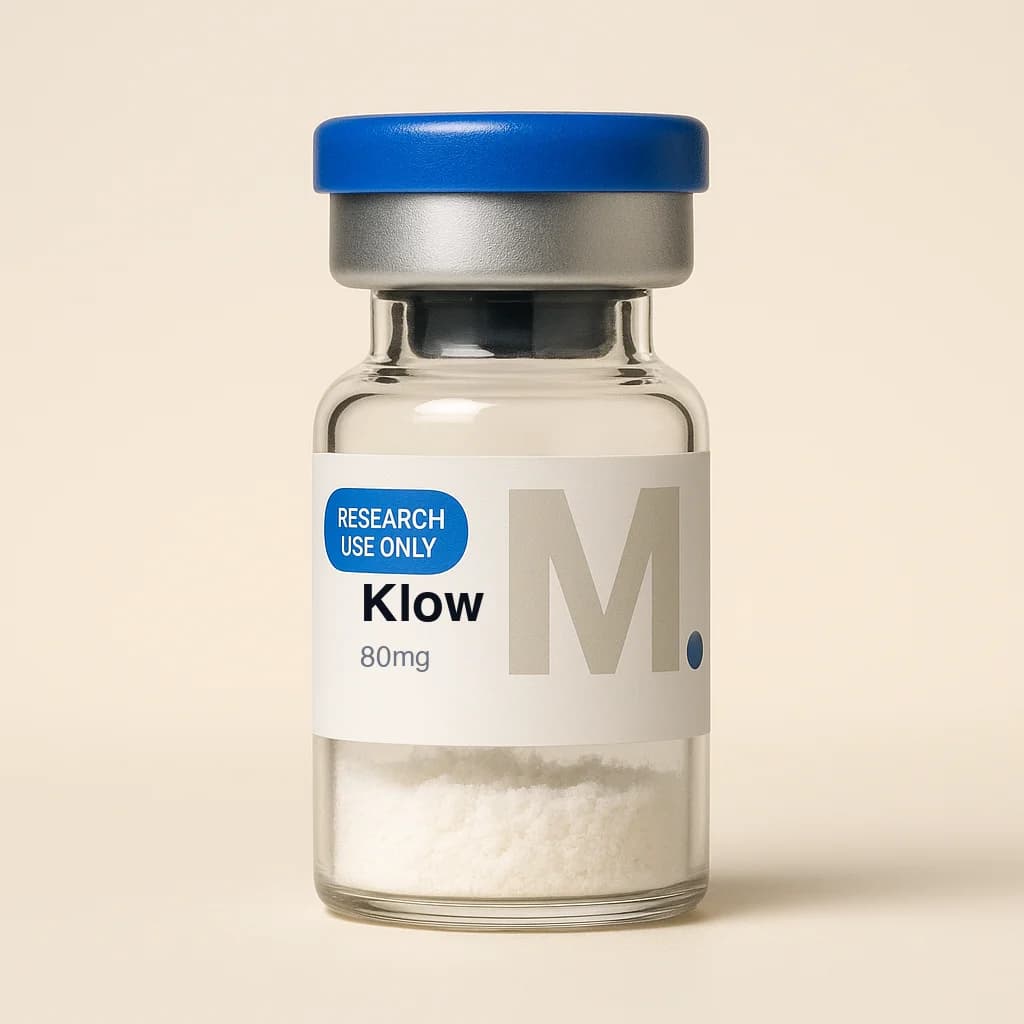
KLOW (BPC-157, GHK-Cu, TB-500, KPV) 80 mg
Lyophilized vial
Per vial
Select your pack size
SingleShips within 48 hours from San Antonio
UPS Ground · tracked + insured · released after independent lab testing
- Purity Guarantee. If a batch fails our ≥99% HPLC standard, full refund + replacement.
- Batch certificate in the COA library, anytime, free
- Same reorder price — forever, no upcharge
$174.99
Single
KLOW (BPC-157, GHK-Cu, TB-500, KPV) in brief
KLOW (BPC-157, GHK-Cu, TB-500, KPV) is a co-formulation of BPC-157, GHK-Cu, TB-500 and KPV in one vial; each component is studied separately in repair and inflammation research. None of its components (BPC-157, GHK-Cu, TB-500, KPV) is approved by the FDA for any use, and no FDA-approved product combines them. Supplied for research use only.
— About this compound
KLOW (BPC-157, GHK-Cu, TB-500, KPV).
Class · Merit co-formulation: BPC-157 + GHK-Cu + TB-500 + KPV
Origin. KLOW is a Merit-specific four-component co-formulation. It extends the GLOW blend with KPV, the C-terminal tripeptide (lysine-proline-valine) of alpha-melanocyte-stimulating hormone (α-MSH).
KLOW combines four peptides recurrent in repair and immune-signaling research: BPC-157, GHK-Cu, TB-500, and KPV. KPV is the C-terminal fragment of α-MSH and is studied for anti-inflammatory signaling that appears, in some models, to act independently of the melanocortin-1 receptor.
As a co-formulation, KLOW has no separate published record; the literature belongs to each component. Merit supplies it as a single research preparation for laboratory use only.
— Common research applications
- Tissue-repair and remodeling research (component-based)
- Inflammation-pathway models (KPV)
- Extracellular-matrix studies
- Comparative peptide co-formulation research
— Mechanism
How it's been studied.
Component-level: BPC-157 (cytoprotection / angiogenesis), GHK-Cu (matrix remodeling), TB-500 (actin / cell migration), and KPV (NF-κB-pathway modulation in inflammation models). No combined mechanism is established for the blend.
Mechanism descriptions reflect findings reported in the preclinical and basic-research literature. They are not clinical conclusions and not statements of therapeutic effect.
— The Chemistry
The numbers, plainly.
CAS
—
Molecular weight
—
Formula
—
Sequence
—
Format
Lyophilized powder
Vial dose
80 mg
Purity (HPLC)
≥99%
Amino acids
—
Half-life
Component-dependent (see the individual component records).
Solubility
Water-soluble. Physicochemical context only. Merit Sciences publishes no reconstitution or preparation procedures.
View the July 2026 batch certificate for KLOW (BPC-157, GHK-Cu, TB-500, KPV) 80 mg → or browse every certificate.
— Why Merit
The supplier difference.
How Merit compares to the two alternatives most research buyers consider for KLOW (BPC-157, GHK-Cu, TB-500, KPV).
Comparison reflects published facility status and standard industry practice. Compounding pharmacy availability of research peptides varies by jurisdiction.
— How it's made
From compound to your shelf.
Every Merit batch follows the same documented path. Five steps, every one verifiable.
- 01
Sourcing
Compound starts as a research-grade API.
Active pharmaceutical ingredient sourced from FDA-registered manufacturers. Identity confirmed against reference standard before any compounding begins.
- API from FDA-registered manufacturers
- Identity verified against reference standard
- Chain of custody documented
- 02
Compounding
Sterile-filled in a US cleanroom.
Lyophilized in a cleanroom at our US facility. The powder format gives ≥24 months sealed stability — no cold-chain shipping required.
- Licensed US facility
- Batch-documented manufacturing process
- Lyophilized powder for transit stability
- 03
Verification
Every batch HPLC-tested.
Reverse-phase HPLC-UV (UV/MS for higher-MW peptides) confirms identity and purity for every batch before it leaves the lab. The chromatogram is archived.
- Reverse-phase HPLC, per-batch
- ≥99% purity floor — every batch
- Chromatogram archived for every batch
- 04
Release
The batch is released against an independent assay.
No batch ships until an independent laboratory has returned its identity and purity results and the certificate is published in the COA library.
- Independent laboratory on every batch
- Certificate published before sale
- Every certificate is in the public COA library
- 05
Dispatch
Ships from San Antonio in 48 hours.
Sealed vials with a QR code on the label that opens the COA library. Order before 2pm CT Monday–Thursday for same-day dispatch. UPS Ground, tracked + insured.
- 48hr dispatch from San Antonio, TX
- QR code on every vial label
- UPS Ground, tracked + insured
Every step above can be verified for any specific batch by emailing support@meritsciences.com with your order number.
— Research references
The published record.
Peer-reviewed work cited in the public scientific literature. Links resolve to PubMed or the publisher of record.
- 01
PepT1-mediated tripeptide KPV uptake reduces intestinal inflammation
Dalmasso G, Charrier-Hisamuddin L, Nguyen HTT, et al. · Gastroenterology · 2008
- 02
Stable Gastric Pentadecapeptide BPC 157: Novel Therapy in Gastrointestinal Tract
Sikiric P, Seiwerth S, Rucman R, et al. · Current Pharmaceutical Design · 2011
Inclusion of a reference does not constitute a clinical claim or recommendation.
— Go deeper
Mechanism, published research and peer-reviewed references for KLOW Blend (BPC-157 · GHK-Cu · TB-500 · KPV), with no product attached.
— Common Questions
Got questions.
Is KLOW (BPC-157, GHK-Cu, TB-500, KPV) FDA-approved?+
None of its components (BPC-157, GHK-Cu, TB-500, KPV) is approved by the FDA for any use, and no FDA-approved product combines them. Supplied for research use only. Two components are named on the WADA 2026 Prohibited List: BPC-157 under S0 and TB-500 under S2.
How is each batch of KLOW (BPC-157, GHK-Cu, TB-500, KPV) tested?+
Every batch is tested by an independent laboratory for identity and HPLC purity before it is listed. Merit identifies batches by date: the current certificate for KLOW (BPC-157, GHK-Cu, TB-500, KPV) 80 mg is the July 2026 batch, 99.79% purity by HPLC, published at meritsciences.com/coa/COA-2026-5HUDMG. The QR code on each vial opens the same page. Open the July 2026 batch certificate →
What does the published research on KLOW (BPC-157, GHK-Cu, TB-500, KPV) show?+
KLOW has no published literature of its own; the research belongs to each component. The BPC-157, GHK-Cu, TB-500 and KPV monographs set out what each record shows and in which models. The KLOW Blend (BPC-157 · GHK-Cu · TB-500 · KPV) monograph at meritsciences.com/library/klow-blend lists the references. Read the KLOW Blend (BPC-157 · GHK-Cu · TB-500 · KPV) monograph →
What is KLOW (BPC-157, GHK-Cu, TB-500, KPV)?+
KLOW combines four peptides recurrent in repair and immune-signaling research: BPC-157, GHK-Cu, TB-500, and KPV. KPV is the C-terminal fragment of α-MSH and is studied for anti-inflammatory signaling that appears, in some models, to act independently of the melanocortin-1 receptor.
How does KLOW (BPC-157, GHK-Cu, TB-500, KPV) work?+
Component-level: BPC-157 (cytoprotection / angiogenesis), GHK-Cu (matrix remodeling), TB-500 (actin / cell migration), and KPV (NF-κB-pathway modulation in inflammation models). No combined mechanism is established for the blend.
What class of compound is KLOW (BPC-157, GHK-Cu, TB-500, KPV)?+
KLOW (BPC-157, GHK-Cu, TB-500, KPV) is classified as merit co-formulation: BPC-157 + GHK-Cu + TB-500 + KPV.
What is the reported half-life of KLOW (BPC-157, GHK-Cu, TB-500, KPV)?+
Component-dependent (see the individual component records).
Why does Merit ship lyophilized?+
Lyophilized (freeze-dried) material is stable in sealed storage: ≥24 months at -20°C. Peptides held in solution degrade far faster, so every compound ships as a dry powder in a sealed vial.
What does "independently assayed" actually mean?+
Every batch is tested by a laboratory independent of the facility that made it, and the certificate is published before the batch is listed. You read the same identity and purity figures we do, which is what separates Merit from a reseller catalog.
How fast does it ship?+
48 hours from order to dispatch, Monday through Thursday. UPS Ground, tracked + insured. From San Antonio, TX, most US addresses receive within 3-5 business days.
— Talk to a Pharmacologist
Question we didn't answer?
Our team answers compound and batch questions the same business day. No bots, no tickets.
Email the team →