Batch-Documented
HPLC-Verified
Independent Assay
Same Reorder Price
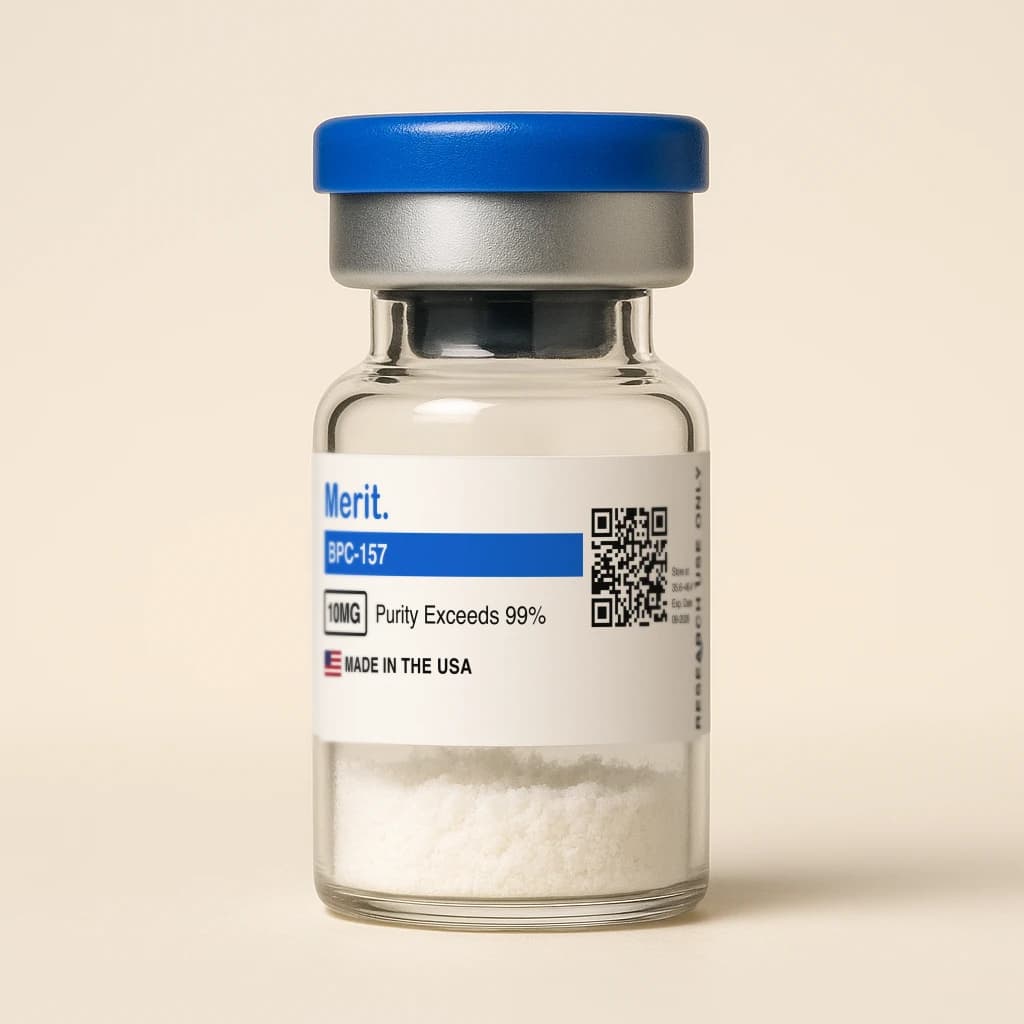
BPC-157 10 mg
Lyophilized vial
BPC-157 — independently assayed, batch-tested, and shipped from our fulfillment facility in San Antonio. Released only after an independent laboratory returns its results for the batch.
Per vial
Select your pack size
SingleShips within 48 hours from San Antonio
UPS Ground · tracked + insured · released after independent lab testing
- Purity Guarantee. If a batch fails our ≥99% HPLC standard, full refund + replacement.
- Batch certificate in the COA library, anytime, free
- Same reorder price — forever, no upcharge
$60.99
Single
— About this compound
BPC-157.
Class · Synthetic pentadecapeptide, Gly-Glu-Pro-Pro-Pro-Gly-Lys-Pro-Ala-Asp-Asp-Ala-Gly-Leu-Val — a partial sequence of the human gastric juice protein designated Body Protection Compound
Origin. Described from the early 1990s onward by Predrag Sikiric, Sven Seiwerth and colleagues at the University of Zagreb, who isolated a 15-residue partial sequence of a protein found in human gastric juice and characterised it in rodent injury models. The great majority of the published literature originates from that group or its collaborators.
BPC-157 is a synthetic pentadecapeptide corresponding to a partial sequence of a protein identified in human gastric juice. Unlike most peptides used in laboratory work it carries no disulfide bridge, no terminal amidation and no unnatural residues, and it is repeatedly reported as stable in aqueous solution and in gastric juice, which is unusual for a peptide of this length and is one reason it appears so often in oral-administration animal work. The sequence is frequently written with the research code PL 14736 in the earlier literature.
The published record is overwhelmingly preclinical. A PubMed search returns on the order of two hundred papers, of which a large majority list Sikiric or Seiwerth as first or senior author, and the experimental subjects are almost entirely rats and mice. Reported observations cluster around tissue-repair endpoints: transected Achilles tendon, transected muscle, colonic anastomosis, corneal injury, and various models of gastrointestinal lesion. A 2019 review by Chang and colleagues collected the musculoskeletal soft-tissue work, and a 2025 systematic review examined the orthopaedic sports-medicine literature specifically, both concluding that the animal evidence is consistent in direction while human evidence remains scarce.
The concentration of authorship in a single research group is the most important caveat a reader should carry into this literature, and it is a limitation the field itself acknowledges. Independent replication outside Zagreb is comparatively thin, and controlled human trials of the pentadecapeptide are largely absent from the peer-reviewed record. Merit Sciences supplies BPC-157 strictly for laboratory research use. Nothing in this entry describes or implies use in humans or animals, and no preparation, dosing or administration guidance is published here.
— Common research applications
- Tendon, ligament and muscle repair models in rodents
- Angiogenesis and VEGFR2/Akt/eNOS pathway investigation
- Gastrointestinal mucosal injury and anastomotic healing models
- Nitric oxide system interaction studies
- Fibroblast migration, survival and outgrowth assays in vitro
— Mechanism
How it's been studied.
The mechanism most consistently proposed in the literature is angiomodulatory rather than directly mitogenic. Work from the Sikiric group reports upregulation of vascular endothelial growth factor receptor 2 with downstream activation of the Akt and endothelial nitric oxide synthase pathway, and a body of related work situates the peptide as an interacting partner of the nitric oxide system, reported as counteracting both excessive and deficient NO signalling in different injury models rather than acting in a single direction. Separate in vitro work by Chang and colleagues reported increased outgrowth from tendon explants, improved fibroblast survival under hydrogen peroxide stress and dose-dependent fibroblast migration, with FAK-paxillin signalling implicated, and a subsequent paper from the same group reported growth hormone receptor as among the most abundantly upregulated transcripts in treated tendon fibroblasts. These are proposed mechanisms drawn from animal and cell-culture models, reported here as literature and not as established pharmacology in any species.
Mechanism descriptions reflect findings reported in the preclinical and basic-research literature. They are not clinical conclusions and not statements of therapeutic effect.
— The Chemistry
The numbers, plainly.
CAS
—
Molecular weight
—
Formula
—
Sequence
—
Format
Lyophilized powder
Vial dose
10 mg
Purity (HPLC)
≥99%
Amino acids
—
Half-life
No reliable human pharmacokinetic figure exists in the peer-reviewed record, and none is asserted here. Circulating half-life values quoted widely in non-academic sources could not be traced to a primary study during preparation of this entry. What the literature does report is unusual stability in aqueous solution and resistance to degradation in human gastric juice, which is the property most frequently cited to explain the peptide appearing in oral-administration rodent protocols. Stated for interpretation of the research literature only.
Solubility
Supplied lyophilised, commonly as the acetate or trifluoroacetate salt. Reported as freely soluble in water and in aqueous buffers. The sequence is rich in proline and contains two adjacent aspartate residues and a single lysine, giving a net negative charge at neutral pH, and it contains no cysteine, so there is no disulfide to reduce or scramble and no methionine or tryptophan to oxidise. Physicochemical context only. Merit Sciences publishes no reconstitution or preparation procedures.
View lab results for BPC-157 → or search by compound.
— Why Merit
The supplier difference.
How Merit compares to the two alternatives most research buyers consider for BPC-157.
Comparison reflects published facility status and standard industry practice. Compounding pharmacy availability of research peptides varies by jurisdiction.
— How it's made
From compound to your shelf.
Every Merit batch follows the same documented path. Five steps, every one verifiable.
- 01
Sourcing
Compound starts as a research-grade API.
Active pharmaceutical ingredient sourced from FDA-registered manufacturers. Identity confirmed against reference standard before any compounding begins.
- API from FDA-registered manufacturers
- Identity verified against reference standard
- Chain of custody documented
- 02
Compounding
Sterile-filled in a US cleanroom.
Lyophilized in a cleanroom at our US facility. The powder format gives ≥24 months sealed stability — no cold-chain shipping required.
- ISO-certified US facility
- ISO-certified manufacturing process
- Lyophilized powder for transit stability
- 03
Verification
Every batch HPLC-tested.
Reverse-phase HPLC-UV (UV/MS for higher-MW peptides) confirms identity and purity for every batch before it leaves the lab. The chromatogram is archived.
- Reverse-phase HPLC, per-batch
- ≥99% purity floor — every batch
- Chromatogram archived for every batch
- 04
Release
The batch is released against an independent assay.
No batch ships until an independent laboratory has returned its identity and purity results and the certificate is published in the COA library.
- Independent laboratory on every batch
- Certificate published before sale
- Every certificate is in the public COA library
- 05
Dispatch
Ships from San Antonio in 48 hours.
Sealed vials with a QR code on the label that opens the COA library. Order before 2pm CT Monday–Thursday for same-day dispatch. UPS Ground, tracked + insured.
- 48hr dispatch from San Antonio, TX
- QR code on every vial label
- UPS Ground, tracked + insured
Every step above can be verified for any specific batch by emailing rx@meritsciences.com with your order number.
— Research references
The published record.
Peer-reviewed work cited in the public scientific literature. Links resolve to PubMed or the publisher of record.
- 01
The promoting effect of pentadecapeptide BPC 157 on tendon healing involves tendon outgrowth, cell survival, and cell migration
Chang CH, Tsai WC, Lin MS, Hsu YH, Pang JHS · Journal of Applied Physiology · 2011
- 02
Gastric pentadecapeptide body protection compound BPC 157 and its role in accelerating musculoskeletal soft tissue healing
Gwyer D, Wragg NM, Wilson SL · Cell and Tissue Research · 2019
- 03
Modulatory effect of gastric pentadecapeptide BPC 157 on angiogenesis in muscle and tendon healing
Sikiric P, Seiwerth S, Brcic L, et al. · Journal of Physiology and Pharmacology · 2010
- 04
BPC 157 and Standard Angiogenic Growth Factors. Gastrointestinal Tract Healing, Lessons from Tendon, Ligament, Muscle and Bone Healing
Seiwerth S, Rucman R, Turkovic B, et al. · Current Pharmaceutical Design · 2018
- 05
Emerging Use of BPC-157 in Orthopaedic Sports Medicine: A Systematic Review
Systematic review, authorship to be confirmed on validation · PubMed-indexed systematic review · 2025
Inclusion of a reference does not constitute a clinical claim or recommendation.
— Go deeper
Mechanism, published research and peer-reviewed references for BPC-157, with no product attached.
— Common Questions
Got questions.
What is BPC-157?+
BPC-157 is a synthetic pentadecapeptide corresponding to a partial sequence of a protein identified in human gastric juice. Unlike most peptides used in laboratory work it carries no disulfide bridge, no terminal amidation and no unnatural residues, and it is repeatedly reported as stable in aqueous solution and in gastric juice, which is unusual for a peptide of this length and is one reason it appears so often in oral-administration animal work. The sequence is frequently written with the research code PL 14736 in the earlier literature.
How does BPC-157 work?+
The mechanism most consistently proposed in the literature is angiomodulatory rather than directly mitogenic. Work from the Sikiric group reports upregulation of vascular endothelial growth factor receptor 2 with downstream activation of the Akt and endothelial nitric oxide synthase pathway, and a body of related work situates the peptide as an interacting partner of the nitric oxide system, reported as counteracting both excessive and deficient NO signalling in different injury models rather than acting in a single direction. Separate in vitro work by Chang and colleagues reported increased outgrowth from tendon explants, improved fibroblast survival under hydrogen peroxide stress and dose-dependent fibroblast migration, with FAK-paxillin signalling implicated, and a subsequent paper from the same group reported growth hormone receptor as among the most abundantly upregulated transcripts in treated tendon fibroblasts. These are proposed mechanisms drawn from animal and cell-culture models, reported here as literature and not as established pharmacology in any species.
What class of compound is BPC-157?+
BPC-157 is classified as synthetic pentadecapeptide, Gly-Glu-Pro-Pro-Pro-Gly-Lys-Pro-Ala-Asp-Asp-Ala-Gly-Leu-Val — a partial sequence of the human gastric juice protein designated Body Protection Compound.
What is the reported half-life of BPC-157?+
No reliable human pharmacokinetic figure exists in the peer-reviewed record, and none is asserted here. Circulating half-life values quoted widely in non-academic sources could not be traced to a primary study during preparation of this entry. What the literature does report is unusual stability in aqueous solution and resistance to degradation in human gastric juice, which is the property most frequently cited to explain the peptide appearing in oral-administration rodent protocols. Stated for interpretation of the research literature only.
Why does Merit ship lyophilized?+
Lyophilized format gives ≥24 months sealed stability at -20°C — significantly longer than pre-reconstituted, which has a 30-day shelf life once in solution. You reconstitute at the moment of use, when potency is at its peak.
How do I check the certificate for my batch?+
The QR code on every vial opens our COA library. Search by compound to find the certificate for the batch currently shipping. No account and no request form, and the library keeps every certificate we have released.
What does "independently assayed" actually mean?+
Every batch is tested by a laboratory independent of the facility that made it, and the certificate is published before the batch is listed. You read the same identity and purity figures we do — that's what separates Merit from a reseller catalog.
Will my bank flag this purchase?+
Statements show as Merit Sciences LLC. Standard merchant descriptor — does not trigger category-code flags. All major cards and PayPal accepted at checkout.
How fast does it ship?+
48 hours from order to dispatch, Monday through Thursday. UPS Ground, tracked + insured. From San Antonio, TX, most US addresses receive within 3-5 business days.
— Talk to a Pharmacologist
Question we didn't answer?
Our team answers compound questions, batch questions, and protocol questions — same business day. No bots, no tickets.
Email the team →